On September 18, 2026, Alibaba's DAMO Academy published a peer-reviewed study in Science describing DAMO RADAR, an open-source generalist medical AI that reads a single contrast-enhanced abdominal CT scan and identifies 146 diseases and conditions across 18 organs. In a reader study built into the same paper, RADAR's standalone diagnostic accuracy outperformed 23 of the 26 practicing radiologists who took part.
 Alibaba
That is a striking headline number, and it deserves the same treatment any striking AI benchmark deserves: read past the top line, check what was actually measured, and separate the parts of the study that are genuinely novel from the parts that come with the usual caveats of any retrospective, single-country reader study.
What RADAR actually does
RADAR is a vision-language model. It takes one contrast-enhanced abdominal CT scan, covering 18 organs from the liver and pancreas through the stomach and colon, and outputs findings across 146 distinct diseases and conditions, including liver, pancreatic, gastric and colorectal cancers alongside chronic conditions like fatty liver disease and acute problems like appendicitis. The model was trained on 424,911 exams and roughly 1.5 million paired images and clinical-report text drawn from those exams.
That single-scan, many-findings design is the part worth pausing on. Most AI radiology tools that have reached clinical use are narrow: a model trained to flag one thing, a lung nodule, a liver lesion, a specific tumor type, on one imaging protocol. RADAR is built the opposite way, as a generalist that reads the whole scan and scores every finding a radiologist would normally look for during a routine abdominal CT read. A generalist model is harder to train well, because it has to learn the visual signature of 146 different things at once rather than specializing on one, and it is judged on whether its accuracy holds up across all of them rather than on a single well-optimized target. That RADAR's mean AUC across all 146 findings still reached 0.913 is the headline result the paper is built around.
What an AUC of 0.913 actually means
AUC, the area under the receiver operating characteristic curve, is a standard way to score how well a diagnostic model separates cases that have a condition from cases that do not, across every possible decision threshold. A score of 1.0 is a perfect classifier. A score of 0.5 is equivalent to random guessing. In practice, AUC scores in the high 0.8s to low 0.9s are typically considered strong for a single diagnostic task in medical imaging; RADAR's 0.913 mean across 146 different findings at once is a materially different achievement than hitting that number on one task.
Mean AUC across 146 findings
Area under the ROC curve, averaged across all 146 diagnostic findings in the study. 1.0 is a perfect classifier; 0.5 is no better than chance.
A 0.137-point AUC gap on a 0-to-1 scale is large for this kind of benchmark; most incremental model updates in medical imaging move AUC by low single digits of a point.
The comparison that gives that number context is the 0.776 mean AUC the paper reports for the best competing vision-language model evaluated on the same 146 findings. A gap of 0.137 points on a 0-to-1 scale is large by the standards of incremental model-to-model comparisons in medical imaging, where updates more commonly move AUC by low single digits of a point. The paper also reports RADAR holding up reasonably well outside its own training distribution: an AUC of 0.895 when evaluated at eight external hospital sites it was not trained on, and 0.904 on more than 27,000 emergency-department CT cases, a harder and more heterogeneous population than a routine scheduled scan.
The model that wins the finance and legal agent benchmarks is not the comparison here; the comparison is whether one CT read can catch what used to take several narrow tools. On that question, a 0.137-point AUC gap over the best prior generalist model is a real answer.
Metir AI analysis
The reader study: assistive, not autonomous
The 26-radiologist reader study is the part of the paper most likely to be summarized as "AI beats doctors," and that framing overstates what was actually tested. RADAR's standalone accuracy outperformed 23 of the 26 participating radiologists on average across the study's cases. That is a comparison of the model reading alone against each radiologist reading alone, not a test of the model operating without human oversight in a live clinical workflow.
The reader study: 26 radiologists, one AI model
RADAR's average diagnostic accuracy beat 23 of the 26 participating radiologists. As an assistive tool, not a replacement, it also changed how the radiologists themselves performed.
23 of 26 radiologists outperformed by RADAR's standalone accuracy3 radiologists not outperformed
These deltas describe radiologists using RADAR as a second reader on a retrospective study, not RADAR reading independently in clinical practice.
The more clinically relevant part of the study is what happened when radiologists used RADAR as a second reader rather than a replacement. With RADAR's output available to them, the radiologists in the study missed 10% fewer diagnoses on average, and read each case more than 30% faster. That is the paper's own framing: RADAR as a diagnostic aid, changing how a human reader performs, not RADAR as an autonomous diagnostician issuing reports on its own. The distinction matters for how a hospital would actually deploy a tool like this. A model that helps a radiologist catch more and read faster fits into existing review and sign-off workflows. A model reading independently would require a different regulatory and liability framework entirely, and neither the paper nor Alibaba's release materials claim RADAR is cleared, or intended, for that.
| Comparison | RADAR result | Context |
|---|---|---|
| Mean AUC, 146 findings | 0.913 | vs. 0.776 for best competing VLM |
| Mean AUC, 8 external hospital sites | 0.895 | Out-of-distribution validation |
| Mean AUC, 27,000+ emergency cases | 0.904 | Harder, more heterogeneous population |
| Standalone accuracy vs. 26 radiologists | Outperformed 23 of 26 | Model reading alone vs. each radiologist reading alone |
| Missed diagnoses, radiologist + RADAR | 10% fewer | RADAR used as a second reader |
| Reading time, radiologist + RADAR | 30%+ faster | RADAR used as a second reader |
Open code, restricted weights
Alibaba released RADAR's code under an Apache 2.0 license, a permissive open-source license that lets anyone use, modify and redistribute it, including commercially. The model weights themselves are licensed separately and more restrictively, for non-commercial use only. That split is a meaningful, deliberate choice rather than an oversight.
Open code under Apache 2.0 means researchers, hospitals and other developers can inspect exactly how RADAR is built, retrain or fine-tune the architecture on their own data, and build on the published methodology without asking permission. It does not, on its own, let a hospital or a health-tech company stand up RADAR as a paid clinical product using Alibaba's trained weights; the non-commercial restriction on the weights means any commercial deployment would need a separate license from Alibaba, or a from-scratch retrain using the open code on the deploying organization's own licensed data, which is a substantially larger undertaking than downloading a checkpoint. For academic medical centers and public-health researchers doing non-commercial evaluation, validation or follow-on research, the current release is a real and immediate unlock. For anyone hoping to build a commercial product directly on Alibaba's own trained weights, it is not.
What the study does not establish
A few limits are worth stating plainly, because they are the difference between "a strong published result" and "a tool ready for routine deployment." The reader study is retrospective, built on cases already collected and read rather than a live prospective trial following new patients through an actual care pathway. Twenty-six radiologists, while a substantial reader study by the standards of this kind of paper, is still a modest sample from which to generalize a "beats most radiologists" claim broadly; how the comparison holds up against a wider and more geographically diverse pool of readers, including radiologists trained and practicing outside the hospitals that supplied the original data, is an open question the paper itself does not close. The training and validation data come predominantly from Chinese clinical centers, and RADAR has been validated specifically on contrast-enhanced abdominal CT, not on non-contrast scans, other body regions, or other imaging modalities like MRI or ultrasound. None of that undercuts the result reported. It does mean the honest reading of "outperforms most radiologists" is "outperforms most radiologists on this benchmark, on this population, on this imaging protocol," which is a narrower and more useful claim than the headline alone conveys.
The broader pattern: specialist models, general access
RADAR is a reminder that some of the most consequential AI progress in 2026 is happening in narrow, deeply technical domains rather than in general-purpose chat assistants, and that the strongest tool for a given job is not always the same model a team already has a subscription to. A hospital research group evaluating RADAR alongside a general-purpose reasoning model for drafting a grant proposal, or a data-science model for analyzing the trial's own statistics, is already living the multi-model reality that specialist and generalist AI now both matter, often on the same project. Metir AI gives teams access to leading general models from OpenAI, Anthropic, Google and others side by side in one workspace, so evaluating and working alongside developments like RADAR does not require standing up a separate tool for every task.
The takeaway
DAMO RADAR is a genuine technical result: a generalist model reading a single CT for 146 findings at once, with a mean AUC well ahead of the best prior competing model, and a reader study showing real gains when radiologists use it as a second opinion rather than a replacement. It is not evidence that AI is ready to read scans unsupervised, and the paper does not claim that. The open code under Apache 2.0 is a real contribution to the field; the non-commercial restriction on the trained weights means the practical unlock, for now, is mostly for research and non-commercial evaluation rather than turnkey commercial deployment. Both things can be true about the same release, and both are worth knowing before repeating the headline.
Sources:
- An expert-level generalist AI for abdominal CT diagnosis | Science
- Alibaba's DAMO RADAR Detects 146 Diseases From One CT Scan, and It's Fully Open Source | AITrove
- Alibaba open-sources RADAR to detect 146 findings in abdominal CT scans | RuntimeWire
- Alibaba's DAMO RADAR AI outperforms 23 of 26 radiologists on 146 diseases | VelocityStartups
- Alibaba Unveils Open-Source Radiology AI That Screens 146 Diseases in a Single CT Scan | Ascendants
- Alibaba open-sources medical AI model that can detect cancer and nearly 150 conditions | South China Morning Post
Image credits
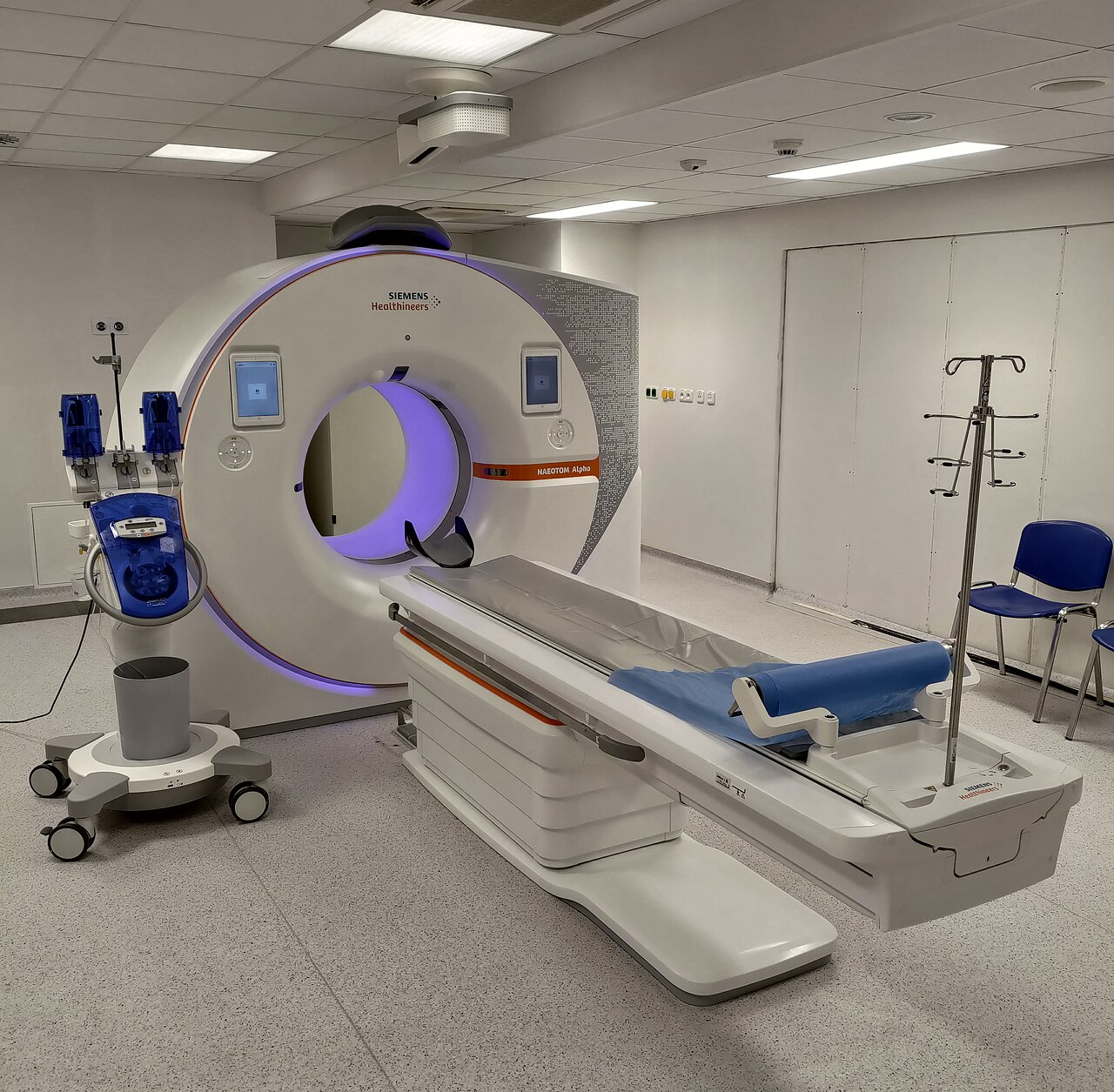
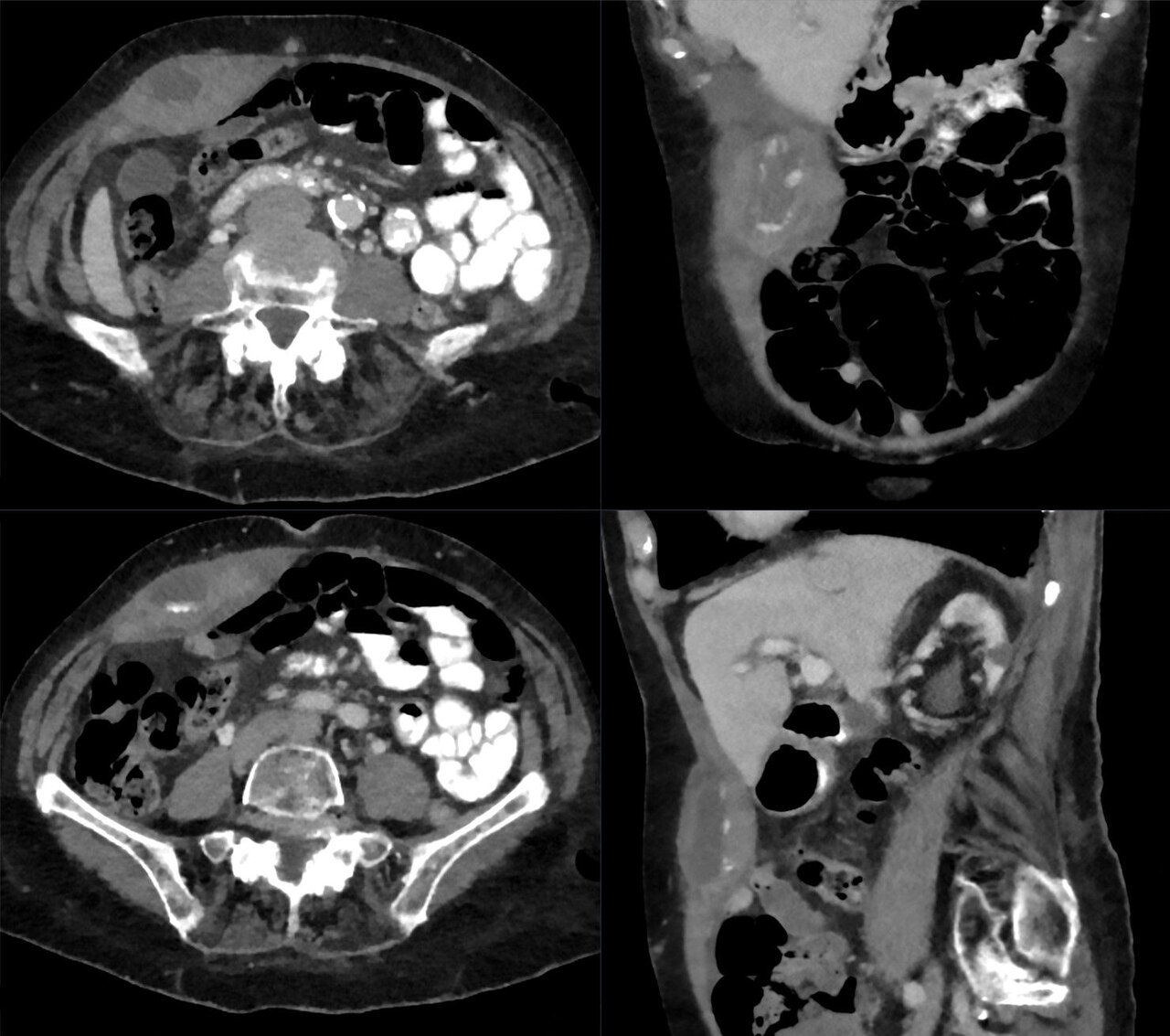
Header image: a modern CT scanner (Siemens Healthineers NAEOTOM Alpha) with a contrast-media injector, photographed in an exam room at Lochotín University Hospital in Pilsen, Czech Republic, by Tomáš Vendiš via Wikimedia Commons, licensed under CC BY-SA 4.0. In-body image: a contrast-enhanced abdominal and pelvic CT scan in axial, coronal and sagittal views, from an unrelated case documenting a rectus sheath hematoma, by Hellerhoff via Wikimedia Commons, licensed under CC BY-SA 4.0. Neither photo depicts DAMO RADAR itself or its output; both illustrate the general imaging equipment and modality the model reads. Alibaba wordmark logo via Wikimedia Commons, public domain.