Add up the 2026 capital-spending plans of the largest technology companies and the figure approaches $700 billion, most of it aimed at artificial intelligence. That is a sum larger than the annual economic output of many countries, committed by a handful of firms in a single year. The spending is not in doubt. What is in doubt is the return. Revenue directly attributable to AI is growing fast but still lags the outlay, debt is rising to fund the gap, and investors have started to ask pointed questions on earnings calls. This piece lays out the numbers as neutrally as possible and then walks through the two honest ways to read them.
The scale, stated plainly
The four largest cloud providers, often called hyperscalers, have each guided toward historic capital budgets for 2026. The approximate figures are Amazon around $200 billion, Google around $185 billion, Meta around $125 billion and Microsoft around $120 billion. Roughly three-quarters of that spending is now directed at AI infrastructure: the accelerators, the high bandwidth memory bolted beside them, the networking, the buildings, and above all the power to run them.
Four companies, roughly $630 billion in one year
Approximate 2026 capital-spending guidance. Around three-quarters of this is earmarked for AI infrastructure: chips, memory, networking, data centers and power.
Figures are approximate guidance and shift with each earnings update. Adding Oracle and other buildouts pushes the industry total toward $700 billion for 2026.
These are not steady-state numbers. They represent a step-change from the prior year, and the rate of increase is the fastest the sector has ever recorded.
A 77 percent jump in a single year
Combined capital spending across the major hyperscalers. The step-up is the fastest in the sector's history, and it is growing faster than the cloud revenue meant to justify it.
Estimates for 2026 range from roughly $630 billion to $725 billion depending on which companies are counted. Morgan Stanley expects related debt issuance to top $400 billion.
A jump of this size in a single year is the crux of the debate. The companies are not spending because the return is proven. They are spending because, in their own framing, being short on compute is the one mistake none of them can afford if AI turns out to be as important as they believe. That is a rational bet under uncertainty, but it is still a bet.
 AWS
AWS Google
 Meta
Meta Microsoft
 NVIDIA
Where the strain is showing
Three signs indicate the spending is beginning to test financial limits rather than flowing painlessly from profits.
The first is the gap between capital spending and the revenue meant to justify it. Across the sector, capex growth is materially outpacing cloud revenue growth. AI is generating real income, but not yet at the rate the buildout implies it must eventually reach. Analysts at Forbes and elsewhere have flagged this widening gap as the metric markets are starting to watch most closely.
The second is debt. Much of this spending can no longer be funded from operating cash flow alone. Morgan Stanley expects AI-related debt issuance across the hyperscalers to exceed $400 billion, and Amazon's free cash flow is projected to turn negative in 2026 as construction outruns cash generation. When a buildout shifts from being paid for out of profits to being paid for with borrowing, the stakes rise, because debt has to be serviced regardless of whether the AI revenue arrives on schedule.
The third is the cost-cutting happening elsewhere to fund it. The clearest example is Oracle, which earlier in 2026 cut roughly 30,000 jobs, about 18 percent of its workforce, to free an estimated $8 to $10 billion a year, while committing to an AI data-center partnership with OpenAI worth more than $300 billion over five years. When a company lays off tens of thousands of people to help finance its share of the buildout, the trade-offs stop being abstract.
When a buildout shifts from being paid for out of profits to being paid for with borrowing, the stakes rise, because the debt must be serviced whether or not the revenue arrives on time.
The demand is real, and it is being contracted years ahead
The bearish signals are only half the picture. On the other side, the demand for AI compute is not speculative in the way a pure bubble would be. It is being locked in through long-term contracts.
A vivid example arrived on July 20, 2026, when Hut 8, a company that pivoted from cryptocurrency mining to AI infrastructure, signed a second fifteen-year lease at its Beacon Point campus in Texas. The lease covers 352 megawatts of capacity with a base-term value of $9.8 billion, bringing the fully contracted campus to a base value of $19.6 billion, and as much as $50.2 billion with renewal options. The tenant is described as a high-investment-grade company. That is not a speculator gambling on demand; it is a creditworthy buyer committing to pay for a gigawatt-scale campus for fifteen years.
The chip supply side tells the same story. TSMC, which manufactures the advanced processors at the heart of this boom, raised its total planned US investment to $265 billion. Companies do not commit sums like that against demand they expect to vanish. The contracted, multi-year nature of much of this spending is the strongest argument that the buildout is infrastructure, not mania.
Supercycle or bubble: the two honest readings
The disciplined way to hold this is to state both cases clearly and resist the urge to declare a winner prematurely.
The supercycle case: this is the early phase of a multi-decade infrastructure buildout comparable to railroads, electrification or the cloud itself. Each of those required enormous upfront capital, looked overbuilt at moments, and ultimately underpinned decades of growth. Demand is being contracted years in advance by creditworthy buyers, and compute has become a genuine input to the broader economy. Under this reading, today's spending is prudent positioning, and the revenue catches up.
The bubble case: spending is growing far faster than the revenue meant to support it, increasingly financed by debt, and concentrated in a handful of firms whose fortunes are now correlated. History shows that infrastructure booms, even ones built on real demand, routinely overshoot and end in write-downs, idle capacity and painful corrections. Under this reading, some of this capital will not earn its return, and the adjustment will be sharp.
| Signal | Points toward supercycle | Points toward bubble |
|---|---|---|
| Demand | Contracted 15 years ahead by investment-grade buyers | Revenue still lags spending |
| Funding | Backed by the most profitable companies on earth | Increasingly reliant on $400B+ in debt |
| Precedent | Railroads, electrification, cloud all paid off | Those same booms also overshot badly first |
| Concentration | Scale enables efficiency | Correlated risk across a few firms |
Both columns are populated with real evidence. Anyone who tells you with certainty which way it resolves is guessing. The most defensible position is that both dynamics are operating at once: the demand is real and the risk of overshoot is also real, and the outcome will vary by company, by asset and by how long the revenue takes to arrive.
What it means for the rest of us
Most people and teams are not deciding whether to build a data center. But this debate still touches them, because the cost of AI they use traces back to this capital cycle. If the supercycle view holds and capacity keeps expanding, compute should get cheaper over time, and the price of running models should fall. If the bubble view plays out and a correction forces retrenchment, capacity and pricing could tighten unpredictably.
Either way, the sensible response for anyone building on AI is to avoid being hostage to a single provider's economics. Costs will move as this cycle evolves, and they will not move uniformly across vendors. Keeping your work portable, so that a shift in one provider's pricing becomes a routing decision rather than a forced migration, is simple insurance against a future no one can forecast. A model-agnostic workspace such as Metir AI is one way to hold that flexibility, letting you follow whichever provider passes on the savings as the capital cycle plays out.
The bigger picture
The $700 billion question does not have an answer yet, and pretending otherwise is the one clearly wrong move. What the evidence supports is a more careful conclusion: the demand underneath this spending is genuine and contracted years ahead, and the financial strain funding it is also genuine and growing. Those two facts are not contradictory. They describe a boom that is both real and risky, which is exactly what most infrastructure supercycles look like from the inside before history decides whether they were visionary or excessive. The useful thing to track is not the rhetoric but the numbers, specifically whether AI revenue growth begins to close the gap on capex before the debt taken on to fund it comes due.
Sources:
- Hyperscalers Hit $700 Billion in 2026 AI Spending Plans | Yahoo Finance
- The AI Capex-to-Revenue Gap Is Widening, and Markets Are Starting to Notice | Forbes
- AI Capex 2026: The $690B Infrastructure Sprint | Futurum Group
- Hut 8 Fully Commercializes 1 GW Beacon Point AI Data Center Campus with Second 352 MW Lease | PR Newswire
- Oracle cuts up to 30,000 jobs to fund AI data centre push | Capacity
Image credits
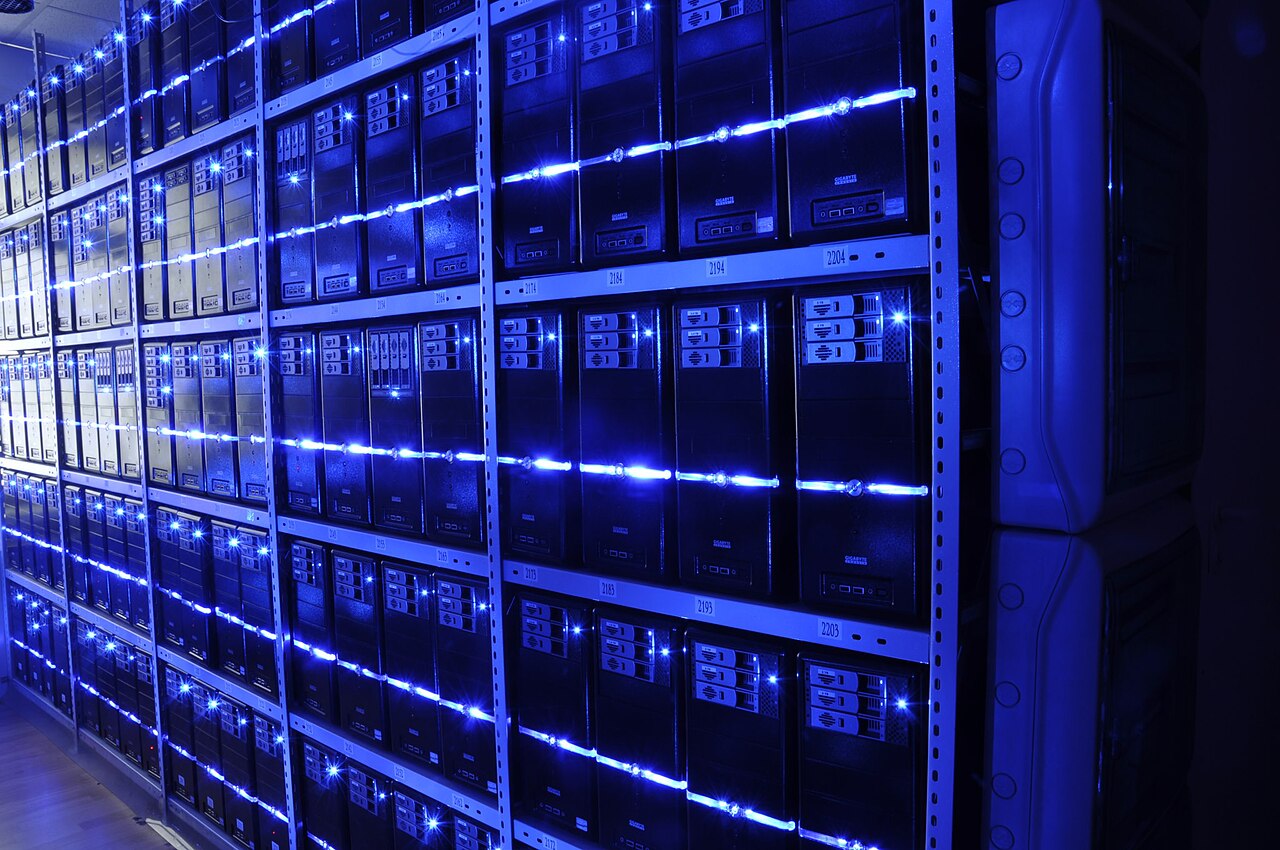
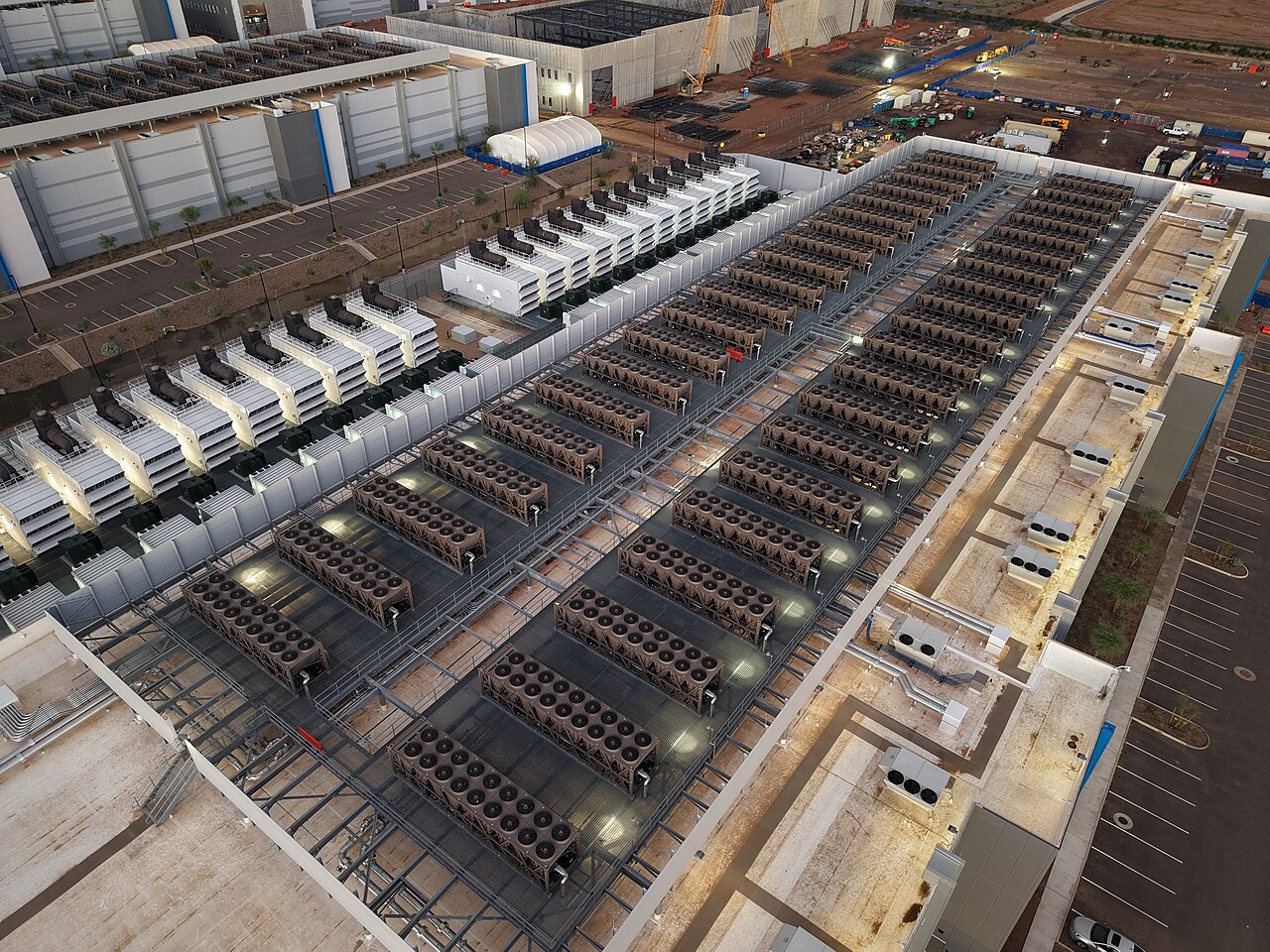
Header image: server racks in a data center aisle, by BalticServers.com via Wikimedia Commons, licensed under CC BY-SA 3.0. In-body photograph of rooftop cooling units at a data center under construction via Wikimedia Commons, released under CC0.