Global shipments of AI glasses rose 263% year over year in the first half of 2026, according to a Counterpoint Research report published in late September. That figure has been widely repeated, but the headline number hides the more interesting finding underneath it: almost none of the glasses driving that growth have a screen. Display-less models, the camera-and-microphone eyewear typified by the Ray-Ban Meta line, accounted for 96% of all AI glasses shipped in the period. The augmented-reality glasses that dominate product renders and keynote demos made up the remaining sliver.
 Meta
Meta Apple
Apple Alibaba
The distinction matters because it changes what the category actually is. A 263% growth rate reads like the arrival of the long-promised AR future. The composition of that growth says something more modest and, arguably, more durable: consumers are buying a familiar object, sunglasses, with a voice assistant, a camera and open-ear audio bolted on, and they are buying it at a price and in a form factor that a heads-up display does not yet support.
Two markets wearing the same name
Counterpoint splits the category into two segments, and reading them separately is the only way to make the growth figure meaningful.
The display-less segment is the volume story. It grew 258% year over year, and Meta commanded 94% of it, with its own volumes up 260%. Xiaomi and Alibaba each held roughly 1%, and everything else combined for about 4%. This is close to a single-vendor market: Meta's partnership with EssilorLuxottica, the eyewear group behind Ray-Ban and Oakley, gives it distribution through optical retail that pure-technology firms cannot easily match, and it has used that to turn smart glasses into an accessory people wear because they look like normal glasses.
The augmented-reality segment, glasses that actually put an image in front of your eye, grew faster in percentage terms, up 449% year over year, but from a tiny base. Its leaderboard is completely different: Rokid led at 41%, Meta followed at 37%, Even Realities held 11% and Alibaba took 7%. This is a genuinely contested market with several credible vendors, but it is still measured in a small share of total units because the hardware is harder, heavier and more expensive.
Two segments, two very different markets
AI glasses shipment growth in the first half of 2026 and vendor share within each segment. The overall market grew 263% year over year.
Vendor shares are within each segment, not the overall market. Source: Counterpoint Research, H1 2026.
The gap between the two segments is the central fact of the 2026 market. The technology that gets the attention is not the technology that is selling.
The geography split is just as sharp
The two segments do not even sell in the same places. Display-less glasses shipped overwhelmingly to Western markets: North America took 50% of units and Western Europe another 28%, together nearly four fifths of the segment. Australia, the wider Asia-Pacific region, Latin America, India, China and the UAE split most of the rest in low single digits each.
The display-equipped segment inverts that. China alone took 45% of AR and AI glasses shipments, with North America at 41% and the rest of the world at 14%. That mirrors the vendor split, where Chinese firms like Rokid and Alibaba are more prominent, and it reflects a domestic hardware ecosystem that is willing to ship display technology into the market earlier and at more aggressive prices.
Where the two segments sell
Regional split of AI glasses shipments in the first half of 2026. The camera-first display-less category is a Western phenomenon so far, while the display-equipped category leans on China.
Source: Counterpoint Research, H1 2026.
The technology that gets the attention is not the technology that is selling.
On the 96% display-less share of the 2026 AI glasses market
Why display-less won first
There is a straightforward engineering reason the screen came second. A bright, power-efficient, full-color display small enough to sit in a normal spectacle lens, driven by a battery small enough to fit in a temple arm, is one of the hardest problems in consumer hardware. Waveguide optics are expensive, they leak light, and they add weight exactly where a wearer notices it most. Removing the display removes all of that at once. What is left, a camera, microphones, a small speaker and a wireless link to a phone, is comparatively mature and cheap.
That trade also changes the interaction model. Without a screen, the primary interface is voice and audio, which is precisely the interface that large language models have made dramatically better over the last two years. A pair of camera glasses that can answer a spoken question about what you are looking at, translate a menu, or start a recording is useful today, on hardware that already exists, without waiting for optics to catch up. The assistant is doing the heavy lifting, and the glasses are mostly a well-placed microphone and camera.
What Apple's entry signals
Counterpoint's report lands alongside reporting that Apple plans to launch its own display-less smart glasses in 2027, built around Siri and Apple Intelligence with cameras, microphones and speakers, while a more advanced glasses-with-display product remains several years further out. The sequencing is the tell. Even the company most associated with premium displays is planning to enter the category screen-first-absent, not screen-first, which is a strong signal that the industry now treats display-less as the beachhead rather than a compromise.
An Apple entry would also test how much of Meta's 94% share is a genuine moat and how much is simply a head start in a market no large competitor had contested. Apple lacks Meta's eyewear-retail partnership, but it has its own distribution, an installed base of phones the glasses would pair with, and a voice assistant it has spent 2026 rebuilding. The competitive question for 2027 is less about optics and more about which assistant, and which surrounding software ecosystem, people want strapped to their face.
The privacy question the numbers raise
A market where 96% of units carry an always-available camera on the wearer's face, concentrated in North America and Western Europe, invites the obvious concern. Counterpoint itself framed part of the display-less segment's growth against a backdrop of privacy questions, and the concern is structural rather than incidental: a camera that others cannot easily tell is recording is a different social object than a phone held up at arm's length. Regulators in several markets have already scrutinized recording-indicator behavior on camera glasses, and that scrutiny tends to intensify with volume. A category growing at triple digits is a category whose norms are still being written.
The takeaway
The 263% figure is real, but the story it tells is not the one the number implies on its own. AI glasses grew because a screenless, assistant-first device turned out to be shippable, affordable and genuinely useful today, while the display-equipped future remains a smaller and more contested market that is largely a Chinese phenomenon so far. Meta's near-total hold on the volume segment is the current headline, but the more important variable is the assistant layer, not the frame. As Apple readies a 2027 entry and Chinese vendors push displays into the market, the hardware will increasingly be a commodity carrier for whichever AI a wearer prefers. That points to a wider pattern across the AI hardware wave: the durable value tends to sit in the model and the software that orchestrates it rather than in any single device, and being able to bring your choice of assistant to whatever hardware you happen to own, rather than being locked to one vendor's stack, is the same portability principle Metir AI applies at the application layer.
Sources:
- Global AI Glasses Shipments Surge 263% YoY in H1 2026, with Display-less AI Glasses Accounting for 96% of Total | Counterpoint Research
- Report: AI glasses shipments surged 263% in H1 2026 as Apple prepares to enter the market | 9to5Mac
- Apple's Smart Glasses to Enter a Rapidly Growing Market | MacRumors
- AI Glasses Shipments Surge 263% | Dataconomy
- AI Glasses Shipments Jump 263% in First Half as Meta Extends Dominance | BigGo Finance
Image credits
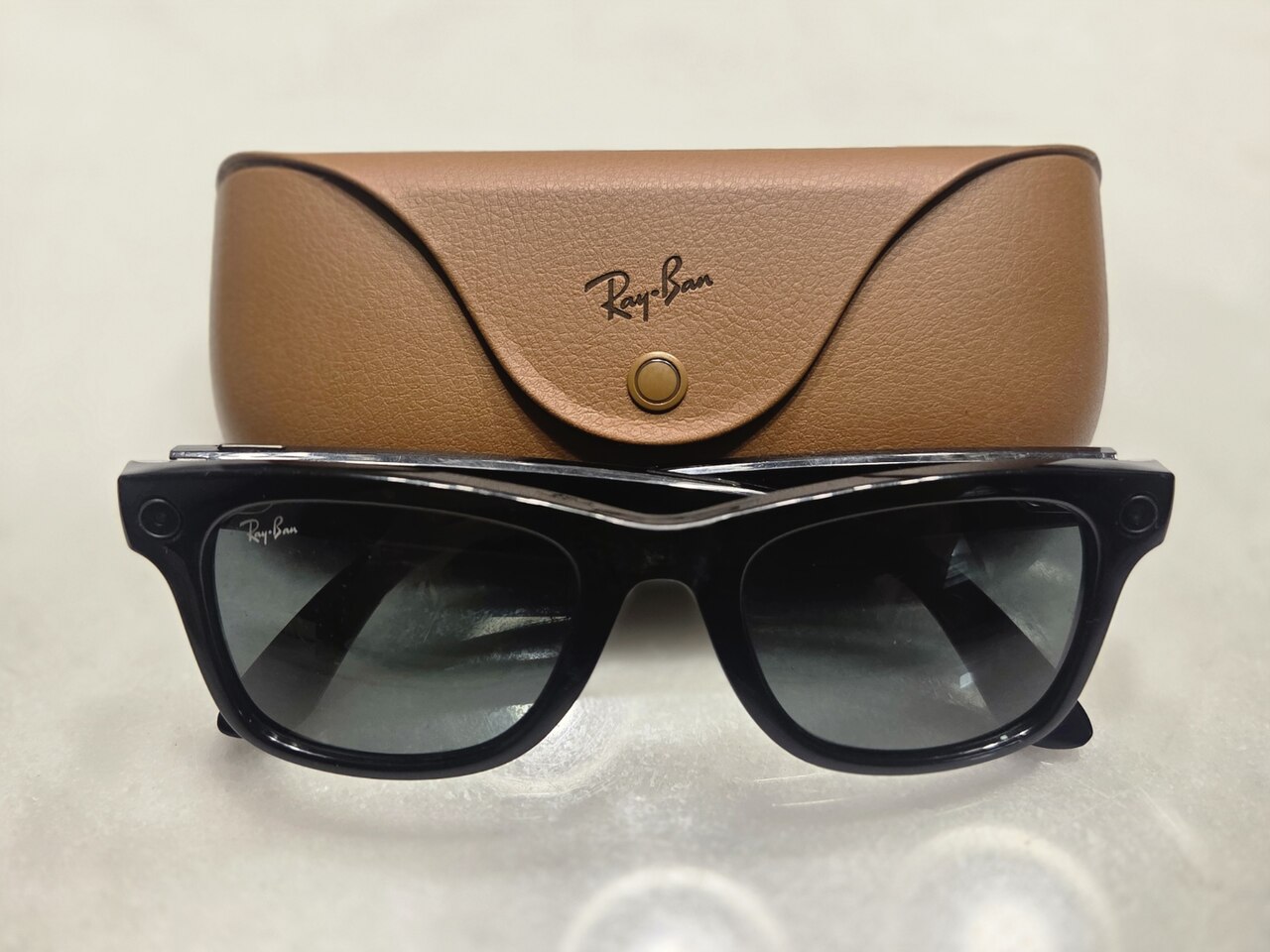
- Hero and in-body figure: "Ray-Ban Meta Gen 1 smart glasses with charging case" by Wikimedia Commons contributor, licensed under CC BY 4.0. Source: Wikimedia Commons. Reviewed before publication; the photograph shows a display-less camera-equipped smart glasses product representative of the category discussed.