
Adobe expects AI shopping traffic to US retail sites to rise 130% year over year this holiday season, according to its 2026 forecast released on September 28. The projection lands alongside a record online sales outlook, and it offers an early look at how much shoppers are letting AI assistants into the buying journey.
What Adobe is forecasting for holiday 2026
Adobe's forecast covers November 1 through December 31, 2026. It projects US online holiday sales of $275.1 billion, up 6.7% from $257.8 billion in the same period of 2025. Cyber Monday is expected to reach $15.1 billion in a single day, up 6.2% year over year, which would be a new milestone for US e-commerce.
The AI number is the headline: traffic from generative AI sources to US retail sites is expected to grow 130% over last year. The gains are not evenly spread. Adobe expects the largest upticks on Thanksgiving (up 159%) and Black Friday (up 95%), the days when shoppers are most actively comparing deals.
The forecast is built on more than 1 trillion visits to US retail sites, 100 million SKUs and 18 product categories, which makes it one of the broader public views of retail behavior.
Projected growth in AI-driven retail traffic, holiday 2026
Year-over-year change, US retail sites. Growth rates, not share of traffic.
Source: Adobe, US holiday shopping forecast, September 2026.
AI as a research channel, not yet a checkout
It helps to be precise about what "AI traffic" means here. In Adobe's framing, the traffic comes from people who use AI tools for research and then click through to a retailer's site. That is a referral channel: the assistant helps a person compare products, and the person still completes the purchase.
That is different from agentic checkout, where an AI agent selects an item and pays on the shopper's behalf. Adobe's forecast describes the first pattern. The second is an emerging capability that several platforms are building, but the numbers here do not measure it. Treating a 130% jump in referral traffic as proof that agents are buying gifts autonomously would overstate what the data says.
Why AI-referred shoppers tend to convert better
Adobe reports that shoppers who use AI as a research tool are more likely to buy, and spend more per transaction, than visitors from non-AI channels. Two plausible reasons follow from how these tools work, though Adobe's release does not test them directly:
- Intent is pre-formed. A person who has already asked an assistant to narrow a category, compare specifications or fit a budget arrives further down the funnel than someone who is browsing.
- Results are curated. An assistant returns a short list rather than a page of ads and listings, so the visitors who click through have already filtered out weaker options.
Higher order values are consistent with shoppers using assistants for considered purchases, though the release does not break spending down by category.
A big percentage off a smaller base
A 130% increase means AI traffic is expected to be 2.3 times last year's level. It does not say how large that level is relative to all retail traffic. Growth rates from a small starting point can look dramatic while the absolute share stays modest. Adobe's release reports growth, not share, so the safest reading is that AI referrals are growing quickly and remain one channel among many, next to search, email, social and direct visits.
Compare that with the overall market. Online sales are forecast to grow 6.7%, so AI-referred visits are expanding roughly twenty times faster than the category they feed into. That gap is the real story: a small but fast-growing entry point into a very large market.
A 130% rise tells you how fast the channel is growing, not how big it has become.
What retailers should take from this
For merchants, the practical implications are about being legible to assistants:
- Answer-engine optimization. Clear product pages, specifications and reviews give assistants material to cite. Retailers that are easy to summarize are easier to recommend.
- Clean product data. With a catalog of 100 million SKUs in the sample alone, structured feeds with accurate price, availability and attributes reduce the chance an assistant misstates an offer.
- Peak-day readiness. If AI referrals spike on Thanksgiving and Black Friday, sites need to handle visitors who arrive with specific products already in mind.
- Measurement. Separating AI-referred sessions in analytics is the first step to knowing whether the conversion premium Adobe reports holds for a given store.
What shoppers should keep in mind
Assistants are becoming a shopping surface, and different tools surface different retailers and prices. Comparing answers across more than one model, and confirming price and stock on the retailer's own page, is a sensible habit. That is also part of why platforms like Metir let people work across multiple models and tools instead of tying research to a single vendor.
The takeaway
Adobe's forecast points to AI assistants becoming a meaningful, fast-growing front door to online retail this holiday season, with better-converting visitors arriving from it. It does not show agents completing purchases at scale, and it does not show AI overtaking established channels. The distance between AI-assisted research and AI-completed checkout is the thing to watch in the next few seasons.
Sources:
- Adobe: US holiday shopping season to hit record
- Spokesman-Review: AI-assisted shopping to rise 130% during holidays
- Chain Store Age: Adobe, US online holiday sales will smash records, reach $275B
- Crypto Briefing: Adobe ChatGPT holiday shopping forecast
- Adobe: Holiday shopping report
Image credits
- Hero: "Shopping online with bank card" by Bogdan Hoyaux / European Commission, via Wikimedia Commons, licensed CC BY 4.0. A generic illustration of shopping online, not related to Adobe's data.
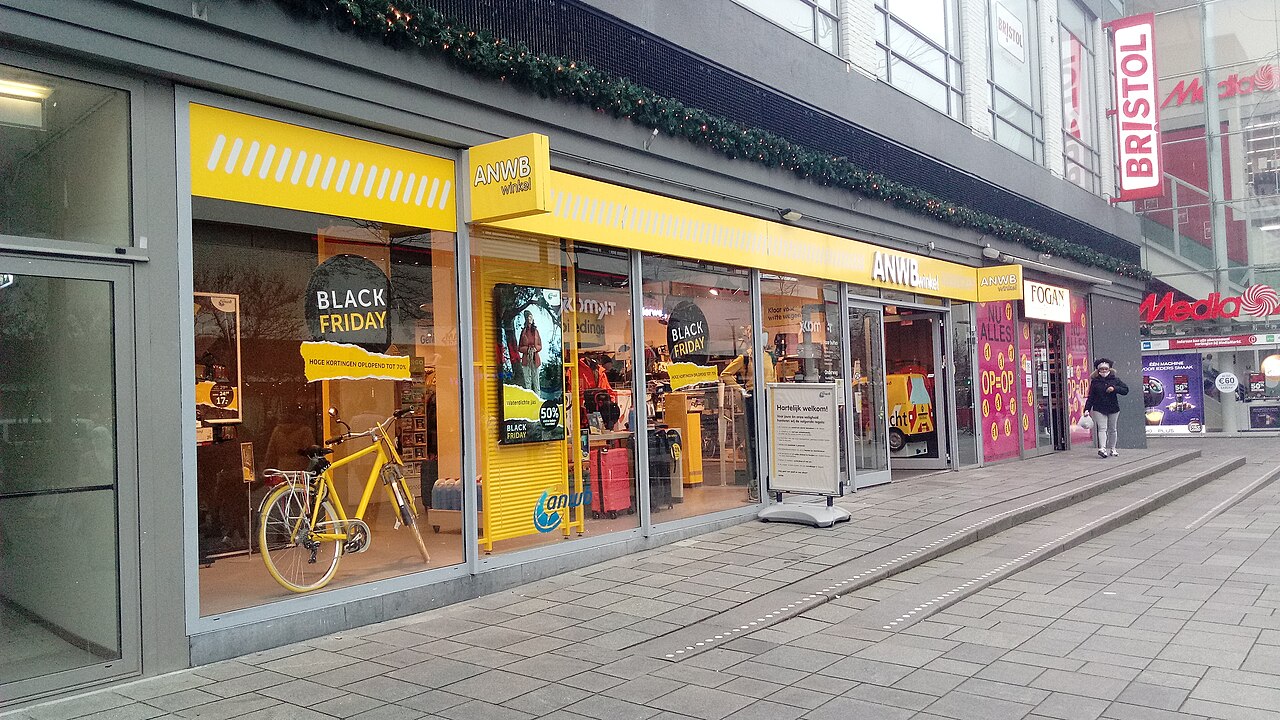
- In-body: "ANWB store during Black Friday, Rotterdam-Centrum, Rotterdam (2020) 01" by Donald Trung Quoc Don, via Wikimedia Commons, licensed CC BY-SA 4.0.